Showing posts with label mosque. Show all posts

20 November 2012

Exploring Ankara


After several weeks without travelling (c'mon I'm an Erasmus, I have to explore!) my trip to Ankara finally happened. Since I had a fried studying Dentistry there who offered housing, I didn't think twice!

Seeing the prices, the bus ride was about 100 TL and the plane travel 120 TL by Pegasus airlines. Since the flight takes only 1 hour and the bus ride lasts roughly 8:30 hours I didn't think twice and booked the flight for the 17th November. My trip would last from Friday to Monday.


The first step was getting into the airport (when I arrived in Izmir in September I had someone to pick me up, this time I caught the Metro until Halkapınar an then the slow Izban until the airport).

The flight went smoothly except for the landing - I had a condition named Aerosinusitis which gave me lots of headaches during the all weekend, but that wasn't properly the airline's fault! Once I landed in Ankara Esenboğa Airport (an interesting airport since it even has an interior lake) I had to take the 442 bus. Ankara transport system isn't one of the best - the metro lines don't reach the airport, not even near. I had to go to the Ankara Transport System website (in Turkish of course, without an English option) and with a little help from Google Translator I somehow figured out were that bus stops. After a 40 min journey, and with the assistance of my phone's GPS, I found out the correct stop (yes, the bus doesn't tell you the name of the stations). After a 15 minute walk from Gazi Hospital until the Beşevler station, I was greeted by my friends who took me to their house - they live with 2 Syrian guys and a female Husky puppy!


The first thing I noticed in Ankara was the weather: cold and dry. Izmir in this time of the year has a temperature around 15ºC-20ºC and it was only 6ºC in Ankara. Being clever as I am, I didn't bring gloves or a bonnet, which lead to frozen, swollen and purple fingers and cold ears. Therefore, my whole description of Ankara is influenced by my bad mood and discomfort!

Everyone told me that there was nothing worth seeing in the capital, but I always want to see things by myself to check if it was true or not. For my three-day stay I made a list of the must-see points:

The Mausoleum of Mustafa Kemal Atatürk - Anıtkabir

Anıtkabir as seen from the sidewalk
The girls' house was very near to this monument, so we simply walked there. For the ones who have to travel by metro, the exit station is Beşevler ankaray station.
The construction of Anıtkabir, which took nine years, commenced on 9 October 1944 with the ceremony of laying the foundation stone. All stones and marbles used o the construction were brought in from various parts of Turkey, to be a representation of the Turkish People's devotion to Mustafa Kemal.

The main building who holds Atatürk's symbolic grave

This is the resting place of Atatürk's body. Having heard so much about Atatürk this past couple of months and seeing how  much the Turkish people love him, I felt really honored being able to be there. The place is surrounded by a beautiful park named "Peace Park" (in honor of Atatürk's famous expression "Peace at home, peace in the world"). The place is huge, having a big open square and a main building.
There is also the Museum, depicting many parts of the modern-Turkey history, almost entirely dedicated to Atatürk. It's really informative if you pay attention, and you can now a bit more about why this man is so adored. You can even learn about the story of Atatürk's funeral, how his body didn't decay and was stuffed. Since the tomb in the main building is symbolic (a.k.a. it's empty) there is a live broadcast of Atatürk's real tomb shown (in a non-accessible part of the museum) on a tv screen! Yes, a live broadcast to a tomb! One of the best parts was the gift shop, were I bought a giant Atatürk 2013 Calender, an Atatürk tie and Atatürk car stickers! I have a bit of Atatürk fever right now.

Gençlik Park

Gençlik Park by night

Later that day we went to Gençlik Parkı, a very beautiful city park (with a Luna park inside it!). This place is specially great in the night because of all the lights it has. During the day time you can appreciate a water-show in the park's immense fountain. It's also an ideal place to lose things - I actually lost my camera there. Luckily my friend found it untouched, laying in a bush half an hour later. Uffs!


The main entrance

Panomara by sunset


The 27.5 ha park is almost at the center of Ankara. Its altitude is about 850 m, which makes it one of the lowest points in Ankara (lowest!). It's surrounded by coffee shops and kiosks, ideal to spend a Sunday afternoon. In the evening, the giant lake fills with lots of water jets playing to the sound of pop music.


The giant wheel, inside Gençlik park


Hacı Bayram Mosque, Temple of Augustus and Rome, and the Column of Julian the Apostate


The next day we had lunch in a fancy place and went straight ahead to visit the Hacı Bayram Mosque, witch had the Temple of Augustus right next to it. The mosque looks old, with some old construction on the front, but since there was nothing in English explaining, we just looked from the outside - nothing special at all. On it's left side lays the Temple of Augustus and Rome - named also Monumentum Ancyranum,where the inscription Res Gestae Divi Augusti, a text recounting the deeds of the first Roman emperor Augustus, was found, the most intact copy of which is preserved on the walls of this temple. Thank God there was a small board with some info in English! There is also a very nice and small fountain in that place and a good view to the hills - Hacı Bayram Park -, where you can see Ankara's Castle.


The Temple of Augustus and Rome

Ancara's Castle as seen from across the hill
Down the hill at the right, hidden in a square, there's the Column of Julian the Apostate, surrounded by administrative buildings. It is popularly known as Belkis Minaresi, or Queen of Sheba and possesses columns derived from Corinthian order. No plaques, no information - if you don't search in advance you won't really know what and old and big column is doing int he middle of a square. It's nothing special if you compare to the ones there are on Istanbul  but I thought it was perfect - placed on the edge of a small garden with a fountain in a quiet place, with a stork's nest on the top.

The Column of Julian and the small park

Kocatepe Mosque


The huge lamp on the center
Our next stop was Kocatepe Mosque. It's about some 3 km if you walk from the Gençlik park. You'll walk in some nice streets with several shops and the typical rush-rush of the big cities. When we arrived there, we thought the entrance was at the street level - and we ended up in a shopping center. A complete mall right underneath the mosque, that's modern (and warm, a nice change from the freezing weather outside)! Once we got off, we found the main entrance of the mosque. Let me tell you, I was completely flabbergasted by this mosque. It's very recent, about 25 years old, but it's grandiosity makes it one of the must-see points of Ankara. Inside, I found an amazing lamp right on the center of the mosque, which is beautifully decorated with Arabic motifs and with a wide open space. I can't exactly tell you what amazed me the most, if the decoration of the grandiosity, but I really really liked this place, I could feel peace inside it - I even made a little prayer =)
Towards the end of the day we went to a fancy street with lots of posh and expensive shops to have a snack before dinner. I didn't want my wallet to be empty so my I decided my stomach should take one for the team.

We did all of those places by walking - undoubtedly the best thing to do if you are sightseeing - but beware that Ankara has lots of hills and few information for tourists. I had the appropriate trainers and my phone's GPS, otherwise I'd be completely lost.

Museums

Naked fat ladies were famous in ancient times
Our third and last day, a Monday morning, began with a trip to the Museum of Anatolian Civilizations. We went by metro until Ulus, the station near Gençlik park, and walked up the hill until the museum. Turns out it was really near the place we were the day before (Hacı Bayram Mosque and the Temple of Augustus). My GPS wasn't working because the sky was too cloudy (my phone isn't exactly new, give it a break) so I just followed the map - finding the museum wasn't very hard but it wasn't easy also. Again, the lack of proper signalization didn't help. There were some shortcuts and stairs to reach the hill top more easily but I just found them when I was coming down from the museum. To tell you the truth the museum was a disappointment - I had my expectations high since I knew it has won some sort of important award and everybody spoke about it in the travel websites. When we arrived I found a cool garden and we entered the building. The collections goes backwards, meaning you enter in the gift shop and to the final part of the museum (????), not to mention the cleaning lady who was vacuuming the floor. After just two rooms, we had come to an end. When asked about this, the security guard told us the bottom floor was closed. Ok... so we walked for an hour to see two rooms. Also, they were charging full price (15 TL). Since I have the Museum Card, I entered for free, but if I was a tourist I'd be pissed and demand for half of my money back (since only half of the museum was opened anyway).

We saw we were near the citadel, Ankara's Castle, so we decided to go a bit further up the hill to enter it. When we reached the top, we saw lots of trucks and constructors. Doubting that was the castle, I approached the rock walls and I saw an inscription (in English, the same text that is on Wikipedia!) and yes, that was the castle. I entered the walls and inside there were some nice restaurants and old houses - but all of those closed due to the works they have there. The floor was dirty, holes opened, mud, water everywhere and lots of noise. We decided it was not worth it and we left.

The Ethnographic museum
Until this point our Monday wasn't the best day but we thought this still could be productive day if we went to the Ethnographic Museum. It has some nice reviews and they say the view of Ankara's landscape was exquisite.  Plus, I knew Atatürk's body had been there for several years until his mausoleum was ready, so it must mean it was worth the visit. After a long walk, the reached the place with the help of my GPS although this place has some signalization. From the main street you can see the writing on the walls saying Ethnographic museum. We entered the place, two good looking buildings and a square in front of them - the gardens were small but the view was excellent  There is an Atatürk's statue on a horse overlooking his mausoleum far away on the other corner of the city, somehow poetic huh? So, outside this placed looked great (it even has a red carpet on the stairs leading to the door), so we entered the museum... only to hear the words "Kapat Kapat"! The museum was closed. At least one of the two buildings was. A bit frustrated, we walked to the other one, but of course it was closed too. It seems everything is closed on Mondays - which is completely stupid and inappropriate  BUT, I can't really complain since in Lisbon, my country's capital, the museum and attractions are closed on Mondays too to complement the stupidity. So, we sort of wasted the morning because we only saw two museum rooms. But hey, better than staying at home sleeping, at least I saw something.

Entrance to the museum... who was closed


Our stay came to and end and we had to go the airport. We chose to go on the same bus that drove us from the airport to the city center the previous time, the 442. We checked the internet to see if the bus stop was the same, and on the website it said we could catch the bus on the other side of the road, which makes sense since the bus is driving to the opposite side now. We waited for more than an hour and the bus never came. Time was ticking and our flight was about to departure in a hour. On the exact moment when I was thinking about hitchhiking to the airport (which is not very likely since we were two guys) or taking an expensive cab, my mate had the cleverness of asking a police that was passing by if the bus even stopped here. Turns out we had to take the bus on the same spot it stopped coming from the airport, then I does a complicated circuit on the city center and goes to the airport on another road. We were lucky enough to have a 442 bus the exact moment we crossed the road to the other side. When we realized the bus was still going to the city center on rush hour and our flight was less than one hour away, we started to panic a bit. That's when we realized the time on the ticket was when the gates opened, the actual flight departed half an hour after that. So, thanks to this little mistake we had a really nice scare but we were there in time.


To sum up, I liked Ankara but just for a few days - the city isn't properly beautiful and attractive for tourism, it's not even ready for serious tourism I guess, the metro system is short (it should at least reach a place close  to the airport) and the payment should be done in a different method since you pay every time you walk away from the station and enter again, even if it is a 3 minute stop to get the newspaper. The traffic is chaotic, the weather is terrible and cold (compared to Izmir at least) but it has several nice thinks also: it's a green city with lots of parks to walk around, they have some really quiet places to live within the city center (it's really good in my opinion, you live in the city but without all the rush) and there are lots of museums to see (but closed on Mondays!). It's a nice place to visit, but just if you are near it or if you like Turkey's history and Atatürk like me. And hey, after all it's always cool to visit the capital!


15 September 2012

Visiting Istanbul, part 2

So, after visiting Basilica Cistern we contoured Hagia Sophia and went into the direction of the Topkapı Palace, which had an entrance fee of 25 TL.

Entrance to the palace

This huge complex of was the primary residence of the Ottoman Sultans for approximately 400 years. The palace complex consists of four main courtyards and many smaller buildings. At its peak, the palace was home to as many as 4,000 people and covered a large area with a long shoreline.

The view to the Bosphorus

We were there at lunch hour, and still the queue was a bit long. There is a lot to see here - we were in a rush so we couldn't afford to see the entire complex with the calm we wanted. I strongly advise you to spend a whole afternoon or even a whole day there if you are interested in history - the best way to get around is to buy an audio tour or a guide book.

Entrance to the war museum inside the palace

No time for lunch, eating a 4 day-old croissant is enough


Once you enter the big gate (with guards on each side) you'll find a big park with a splendid view to the Bosphorus. If you turn left, you'll see the Istanbul Archaeological Museums. When you reach the actual palace, you'll have the ticket office at your right. Once you've passed another gate, you'll be in the front palace garden. Even inside the palace you have queues to enter in the several rooms. What most impressed me was the treasury all, with all the gold, diamonds and crazy emeralds and sapphires.Would they notice if I borrowed on of those? =)

Some of the many treasures you can see inside the palace
Like most of the monuments in Istanbul, Topkapi palace is beautifully decorated

As the centuries passed the sultans built several small buildings which had many functions - private rooms, libraries, the turbans room, the circumcision building(??), etc. If you want to enjoy your visit even more you can buy and extra ticket and see the Harem, were all the female companions of the sultan lived.


One of the many rooms/small buildings that the sultans built over the centuries

Inside the private library of the sultan

I can't stress out enough how much this complex has to see. We were in a rush, we basically entered the places, took a quick glance and left. If you want to have the full experience, take some time (and a guidebook) to really see the palace.

Fine view to Istanbul's old town from the palace

Part of the Milion
The next stop was Divan Yolu street, at the right of Ayasofia. This street was once the imperial road from Constantinople to Rome, laid out by Constantine the Great in the early 300s AD. The beginning-point of was marked by the Milion: four towers at the corners of a square footing, topped by a dome. The Milion was apparently razed in the 15th century, but remnants of it were discovered in the 1960s, and a short marble shaft was re-erected at the northeastern end of Sultanahmet Square in the little park above Basilica Cistern. You'll have to look for it, because it's  a small monument and can be easily missed. Divan Yolu is now the main avenue through historic Old Istanbul, starting at Sultanahmet Square (the square between Ayasofia and the Blue Mosque) and the Hippodrome and heading westward to the Grand Bazaar.


Part of the ancient city walls can be spotted at several places in the city 

The Burnt Column
The Burnt Column
The road is full of shops and restaurants, past Ottoman sultans' tombs, mosques and souvenirs shops. If you want to bargain a bit, try it here. Further along the road you'll find Çemberlitaş, the Burnt Column -a Roman monumental column constructed on the orders of the Roman emperor Constantine in 330 AD. It commemorates the declaration of Byzantium as the new capital city of the Roman Empire. The Column of Constantine is one of the most important examples of Roman art in Istanbul. The column is 35 meters tall today. Restoration work has been going on since 1955. Cracks in the porphyry were filled and the metal brackets renewed in 1972. On its erection, the column was 50 meters tall, constructed of nine cylindrical porphyry blocks surmounted by a statue of Constantine in the figure of Apollo. Earthquakes and a fire in 1779 destroyed the neighborhood surrounding the column, leaving it with black scorch marks and earning it the name 'Burnt Column'.

A few dozen of meters ahead, you'll find the Grand Bazaar at your right. The bazaar is is one of the largest and oldest covered markets in the world, with 61 covered streets and over 3,000 shops. Once you get in, you'll have to orientate yourself because you can get easily lost. The market is packed with the most bedazzling stores - you can find everything there from souvenirs, fridge magnets, leather to real diamonds. You can and should bargain, but know that if you just want simple souvenirs like magnets or t-shirts, you'll probably find better prices on the streets.

One of the entrances to the Grand Bazaar

A jewelery with lots and lots of gold in the bazaar
A fine selection of natural herbs you can find in the bazaar

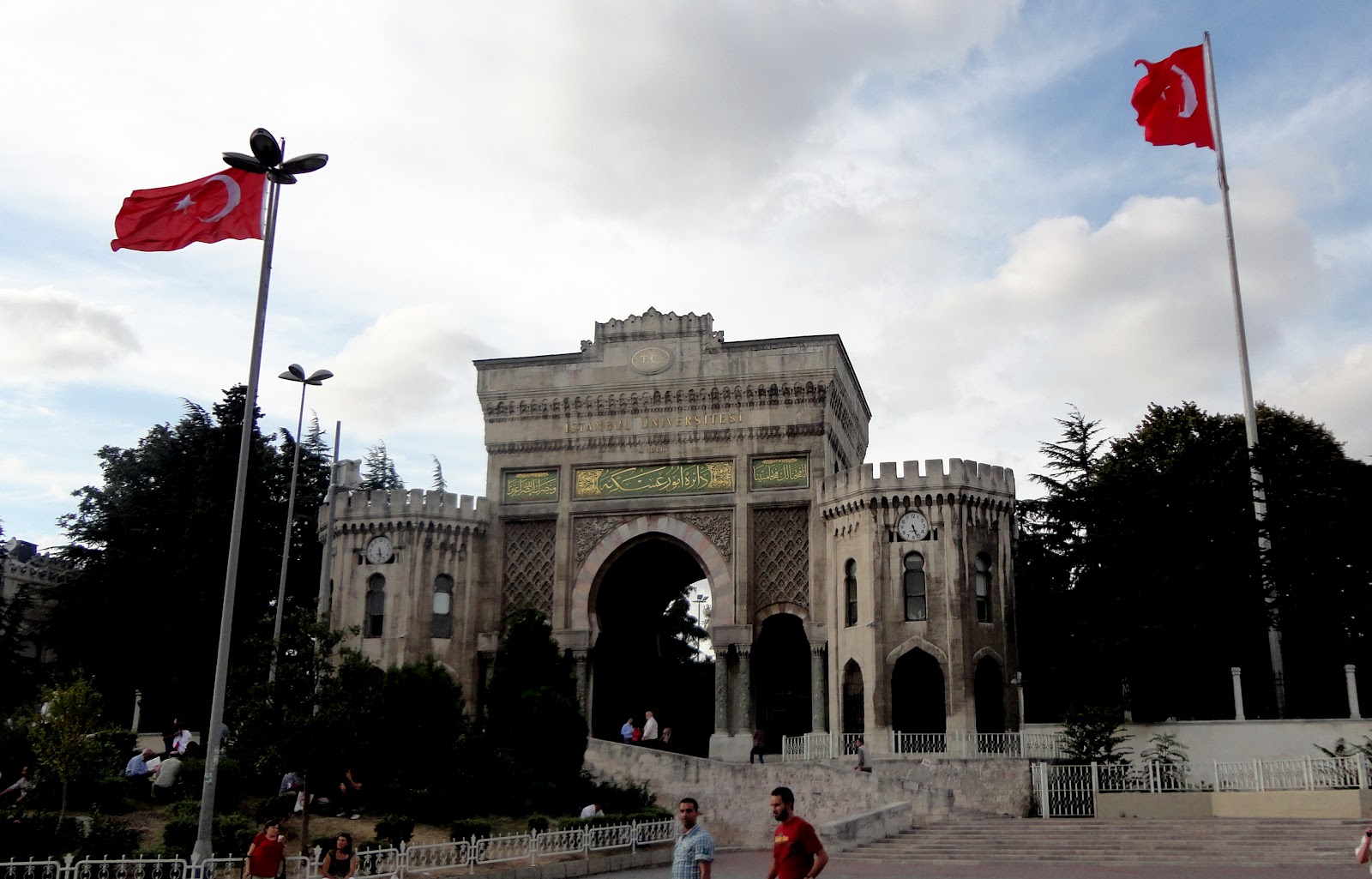
Once we bought the sought-after souvenirs (at a slightly higher price I might add), we went to our last spot for the day, Beyazıt Square, were we could find the imponent Istanbul University's gate. The walled Istanbul University campus was built as the Ottoman Ministry of War, which accounts for its martial, fortress-like aspect. There was plenty to see here, such as the Mosque of Sultan Süleyman or the spice market, but after a day like this we were completely exhausted and went back to Divan Yolu street to eat something and went to the hotel.

Istanbul University's gate at Beyazıt Square


The following day, a bit more refreshed, we woke up at 8 am an went straight to the Istanbul Archaeology Museums, located just before the gate to Topkapı Palace with an entrance fee of 10 TL. The Archaeolgy museums are constituted by three buildings: Archaeological Museum (in the main building), the Museum of the Ancient Orient and the Museum of Islamic Art. On the way to the buildings you'll find relics in the sidewalk!

To many artifacts - why not put them on the sidewalk?

We first visited the museum of Ancient Orient, with many, many interesting relics including the Kadesh Peace Treaty, the oldest known peace treaty in the world. You can also see artifacts of many civilizations  the Egyptian, Sumerian among others.

Kadesh Peace Treaty
Part of the Kadesh Peace Treaty

Egyptians artifacts

The next building was the Museum of Islamic Art. It's quite small, but the decoration is awesome! The tiles are amazing, you can really see the best of the Islamic decoration there.


Tiles from the Museum of Islamic Art

Last but not the least, the Archaeological Museum, the main building, is pretty big and has lots and lots of interesting stuff to see. I found artifacts from nearly every place I went, like parts of the Serpent Column in the Hippodrome, Ayasofia and even the story of the Küçuk Ayasofya, that old mosque in front of our hotel! One of the most famous pieces is the Alexander Sarcophagus, once believed to be prepared for Alexander the Great.


Istanbul Archaeological Museum
The main building, the Archaeological Museum


Alexander Sarcophagus
Alexander Sarcophagus 

This place really has a lot to see, but since we were in a hurry (the airport transfer was scheduled to 12pm) we couldn't appreciate it the way I wanted - 3 hours went really fast.
Back to the hotel, with 20 minutes to spare, we checked out, headed towards the airport and left for our next and final stop: Izmir.
My conclusion: Istanbul seems to be a bubbling city filled with life and lots and lots to see. With only one day and one morning I wasn't able to see the Sultanahmet area properly - only took a quick look and moved on. If you want to see the entire city, you'd need more than one week, perhaps two. It's really gigantic, but if you have the means to do so, you won't regret it.

One last glance to Istanbul...
... and a merhaba to Izmir!


14 September 2012

Visiting Istanbul, part 1

My first contact with Turkey was made in Istanbul, more precisely the Atatürk International Airport. I arrived in the night what could make using the public transportation to reach the hotel a bit complicated - so I decided to book a transfer from the airport to my hotel. Once I arrived, I tried to withdraw money - Turkish Lira - but the ATM gave me errors instead. Twice. I later knew that I shouldn't have asked for a receipt, hence the error. Even though I had no success getting the money, the full amount was discounted from my bank account, and it took two longs weeks and inumerous phone calls to solve the problem.
As soon as I left the arrivals area of the airport, there was a man waiting for me and my mate, and took us to the hotel - Antik Sofia Otel. Because the hotel is located in a family neighborhood  in the historical district of Sultanahmet, we really could feel the ambiance of life in Istanbul - although it was a bit small, the owner and the location were just right, so if you are on budget I would recommend it. Hearing the callings for praying from the old mosque at 5 am has it charm.


Antik Sofia Hotel
The Antik Sofia Hotel


Küçuk Ayasofya Mosque
The Küçuk Ayasofya Mosque -  formerly the Church of the Saints Sergius and Bacchus -  right in front of the hotel.
Since we only had 2 days, more specifically one full day and a morning to see the entire area, I planned the trip in advance - we only visited Sultanahmet, but went to the most eye-catching places. We were really close to the touristic area, so we walked all the way without taking transports.

Sultanahmet map
Everything had to be planned in advance. Turkey Travel Planner helped a lot!

The first stop was the Hippodrome - a big square right next to the Blue Mosque. In the ancient times it was the heart of Constantinople's political and sporting life. Now it's called the "At Meydanı" (Horse Grounds) because of its function in Ottoman times. Travel guides says that there is free wifi - I couldn't access a free network though. The Hippodrome has several monuments:


Obelisk of Thutmose III
The Thutmose Obelisk in the hippodrome
  • Serpent Column - All that remains is the base, the column was cast to celebrate the victory of the Greeks over the Persians during the Persian Wars in the 5th century BC. Constantine ordered the Tripod to be moved from the Temple of Apollo at Delphi, and set in middle of the Hippodrome.  Parts of the heads were recovered and are displayed at the Istanbul Archaeology Museum.
  • Obelisk of Thutmose III - brought by emperator Theodosius in 390, the obelisk from Egypt was erected inside the racing track. Carved from pink granite, it was originally erected at the Temple of Karnak in Luxor during the reign of Tuthmosis III in about 1490 BC. Theodosius had the obelisk cut into three pieces and brought to Constantinople. The top section survives, and it stands today where Theodosius placed it, on a marble pedestal. The obelisk has survived nearly 3,500 years in astonishingly good condition.
  • Walled Obelisk - built in the 10th century the Emperor Constantine Porphyrogenitus. It was originally covered with gilded bronze plaques, but they were sacked by Latin troops in the Fourth Crusade.

Walled Obelisk
The Walled Obelisk


Since the Hippodrome is close to the main touristic places - Hagia Sophia, Topkapı Palace, the Blue Mosque and the the Basilica Cistern, we could easily choose what to visit next. We decided that the next stop would be Hagia Sophia (Ayasofya in Turkish) - since we were there early, about 9 am, we could enter the museum without having to wait too much. And that was wise since a few hours later the queue was several meters long! The entrance costs 25 TL, but it's well worth it - this building is almost 1500 years old, being built as a church in 537 AD.  It was proclaimed a mosque soon after the conquest of the city from the Byzantines in 1453. When it was transformed into a mosque, the christian mosaics were covered in plaster but not destroyed. It served as Istanbul's most revered mosque until 1935 when Atatürk, recognizing its world-historical significance, had it proclaimed a museum, as it is now. Most of the 30 million gold mosaic tiles which cover the church's interior—especially the dome—have recently been restored.


Hagia Sophia in the early morning


Hagia Sophia by night

The amazing mosaics from the time when it was a church

The interior of the museum

When you leave Ayasofya you can turn left, and then left again to see the Sultan Tombs. The entrance is free, and there isn't much to see here except for... tombs. The entrance is free, so if you have the time take a look. The mausoleums are decorated with an Arab style and you'll have to take your shoes off to enter. If you like history you'll see the tombs lots of well-known sultans.

The interior of one of the mausoleum
Right in front the tombs and Ayasofya is the Blue Mosque, also called the Sultanahmet Camii. It earned its name because of the blue interior tiles. Being one of Istanbul's premier sights, we had to wait in the queue for a bit. Since it's a working mosque, you can enter for free (though donations are gratefully received at the exit). It's closed to non-worshippers for a half hour or so during the five daily prayers, and may be closed for a longer time from midday on Friday, the Muslim holy day. At the entrance we were asked to put our shoes in a plastic bag, and the ladies who had her beautiful legs too exposed were asked to cover them with a scarf. The interior of the mosque was astonishing - being my first time on a real mosque, I was really impressed. There are no statues like in the catholic churches, just a big open space with a carpet. The interior is really well adorned as you can see from the pictures.

The Blue Mosque from the Hippodrome

Blue Mosque
The Blue Mosque

A working mosque - prayer times

The beautiful ceilings of the Blue Mosque
Our next stop was the Basilica Cistern - one of the hundreds of Byzantine cisterns on the underground of Istanbul, from the days it was Constantinople. It really big, covering almost 1 km2 and having 336 marble columns, costing 10 TL to enter. Built by Justinian after 532, the Basilica Cistern stored water for the Great Palace and nearby buildings. Lost to memory, it was rediscovered by Petrus Gyllius, who noticed that local people got their water by lowering buckets through holes in the floors of their houses, found an entrance and thus put it back on the map. Once you get in you can feel the saturated atmosphere and the dark illumination to set the mood. It's a shame that the whole environment is spoiled by people shouting trying to sell pictures and souvenirs. Even so, really worth a visit.

The interior of the Basilica Cistern with its 336 marble columns taken from pagan temples in Anatolya


Aaaand it's enough for this post, don't forget to see part 2 ;)